
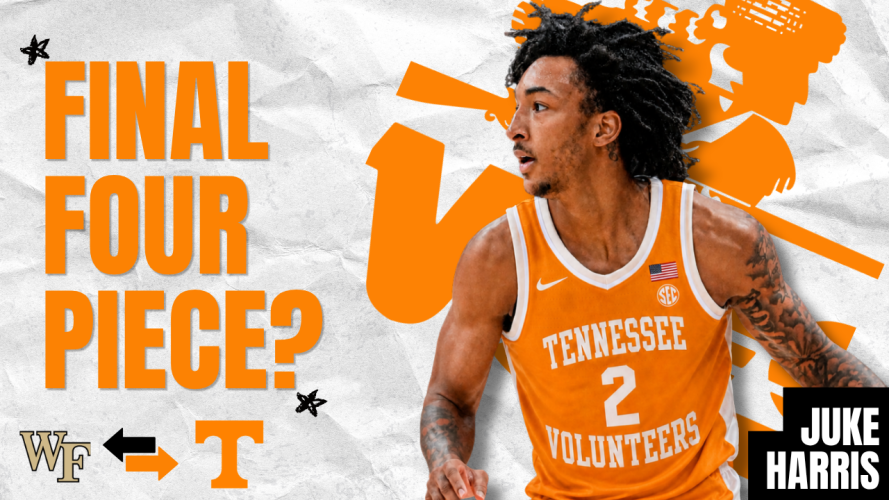
Rick Barnes and the Tennessee Volunteers were already building something special in the transfer portal. Then Juke Harris committed — and the conversation changed entirely.
The 6’7 Wake Forest guard is one of the most dynamic offensive players to enter the portal this cycle, and landing him on top of an already loaded roster doesn’t just make Tennessee better. It makes them genuinely dangerous come March.
Here’s a deep dive into what Harris brings to Knoxville and why this fit might unlock the most efficient version of his career.
The Problem at Wake Forest
To understand why Tennessee is such a perfect landing spot, you have to understand the situation Harris was leaving behind.
At Wake Forest, Juke Harris was the offense. He had nearly more free throw attempts than the next highest player had total shot attempts. Every scouting report had him at number one with a bullet. Every defensive scheme was built around stopping him first.
And he was still effective — that’s how good he is.
But the numbers tell the real story. Last season, Harris shot 153 guarded catch-and-shoot attempts and only 72 unguarded. For a player whose efficiency spikes dramatically on open looks — he shot 43% on unguarded catch-and-shoot jumpers — those numbers are almost backwards. The talent around him simply couldn’t command enough defensive attention to buy him space.
That changes completely in Knoxville.
A Three-Level Scorer with No Ceiling
Before we get into the fit, let’s be clear about what kind of player Tennessee is getting.
Juke Harris is a legitimate three-level scoring threat. At 6’7 with a strong frame, he can shoot over smaller guards and punish any defender who gets caught under a screen. But he’s not just a perimeter shooter.
- At the rim: Athletic enough to turn the corner and finish, even if it’s not his prettiest tool.
- Mid-range: Excellent touch on floaters and runners, comfortable pulling up off the dribble.
- From three: Elite. Prodigious. The kind of shooter that has to be accounted for the moment he crosses half court.
The result is a player that defenses genuinely can’t take out of a game. You can’t sag off him. You can’t go under screens. And if you overplay him, he puts it on the floor and gets to the rim.
There is no clean answer. There’s only picking your poison.
Why the Tennessee Fit Is a Win-Win
Here’s where it gets really interesting for Volunteers fans.
Tennessee returns and adds multiple players who will command serious defensive attention — guys like Terrence Hill, Day-Day Ames, and Tyler Lundblad. These aren’t fillers. Defenders can’t simply abandon them to help on Harris, especially not Lundblad or Hill.
That creates a genuine decision point for opposing defenses every single possession. And both outcomes favor Tennessee.
Scenario A: Defenders stay attached to Tennessee’s shooters, and Harris gets more unguarded looks in space. His efficiency jumps. Tennessee’s offense becomes nearly impossible to contain.
Scenario B: Defenses cheat toward Harris the way Wake Forest’s opponents did. Hill, Ames, and Lundblad get open. Tennessee makes them pay from the perimeter.
There’s no Scenario C where the defense wins. That’s what makes this roster construction so dangerous.
The Off-Ball Piece Nobody Is Talking About
One of the most underrated aspects of this fit is what happens when Harris doesn’t have the ball.
At Wake Forest, off-ball possessions were rare — only about 10% of his time on the floor. But when those situations did arise, the results were eye-opening:
- 40% from three on off-screen looks
- 60% from two in those same situations
Nobody is suggesting Tennessee turns Harris into a spot-up wing. He’s at his best with the ball in his hands, and that’s how Rick Barnes should use him. But the ability to run him off screens — even occasionally — gives Tennessee another wrinkle that opponents have to prepare for.
More importantly, it gives Harris rest. At Wake, he was involved in virtually every meaningful possession. That wears on a player over the course of a full season. At Tennessee, with multiple ball-handlers and scorers on the floor, Harris can let others take their turn and re-enter possessions fresh.
Over 30+ games, that adds up — in energy, in health, and in efficiency.
The March Madness Ceiling
Tennessee was already expected to compete in the SEC before this commitment. They were a good team trending upward.
Juke Harris makes them a Final Four conversation.
The combination of perimeter shooting, playmaking, interior presence, and overall depth gives this roster an answer for almost any defensive scheme a tournament opponent could throw at them. The pace can be adjusted. The shot profile is diverse. And with Harris drawing attention, everyone else gets easier looks.
The one area to watch? Buy-in.
When you bring in this much talent through the transfer portal, someone has to accept a smaller role than they’ve had before. Ames may need to embrace a high-usage bench role. Others may see their shot volume dip. It only works if everyone is pointed in the same direction — something Rick Barnes will need to manage carefully through the early part of the season.
Tennessee might also benefit from adding a more defensive-minded wing and a backup five who can give Ruben rest and handle the physicality of SEC play when foul trouble hits.
But those are fine-tuning issues. The foundation is there.
Final Thoughts
Juke Harris to Tennessee is one of the most impactful transfer portal moves of this entire cycle. He’s not just a good player going to a good program — he’s the right player going to the right program at exactly the right time.
For Harris, Tennessee offers the supporting cast he never had. For Tennessee, Harris is the offensive weapon that elevates them from SEC contender to national threat.
Get your bracket pencils ready, Vols fans. This one matters.
Want more film breakdowns and transfer portal analysis? Visit us at scoutteamsports.com and subscribe on YouTube so you don’t miss a thing.
#CollegeBasketball #TransferPortal #Tennessee #JukeHarris #MarchMadness #ScoutTeamSports








Add comment