
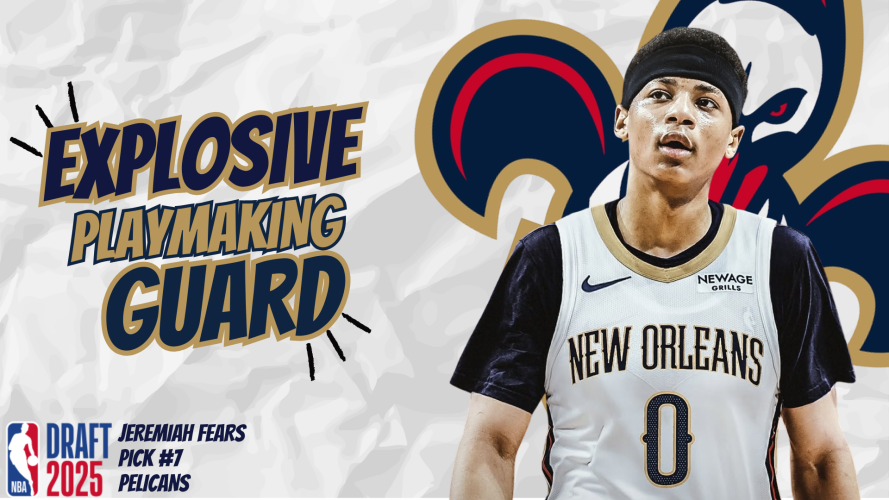
When the New Orleans Pelicans selected Jeremiah Fears with the 7th pick in the 2025 NBA Draft, they didn’t just add another guard — they took a swing on one of the class’s most explosive backcourt athletes. Fears’ tape is a blend of elite end-to-end speed, confident scoring, and flashes of playmaking feel. The question — as with most rookies who carried heavy usage in college — is how quickly the efficiency and decision-making catch up.
Summer League Snapshot: Flashes and Friction
Across a small sample, Fears showed exactly why he intrigues: burst, pressure on the rim, and the confidence to create offense on command. The flip side was familiar rookie turbulence — streaky efficiency and turnovers — the kind of early noise you expect when a young guard tests his limits against NBA length and schemes. In other words: enough juice to justify the pick, enough messiness to map the development plan.
Transition Game: Every possession can be a fast break
With Fears on the floor, any rebound or turnover can become a layup the other way. At Oklahoma, he shot 58% in transition, produced over 1.0 points per possession, and ranked in the 75th percentile for time spent in the open floor. That’s not just straight-line speed — he’s crafty, uses angles, and finishes creatively over size. He reads space and punishes hesitation, forcing defenses to sprint back and organize on every miss.
Shooting Profile: Catch-and-Shoot optimism vs. pull-up reality
On paper, the overall percentages don’t flatter him. The film adds nuance. In catch-and-shoot situations, Fears hit 36%+ on 61 attempts, and 38%+ when unguarded. The mechanics are encouraging: quick feet to square, a clean, repeatable release, and minimal wasted motion. The trouble spot was off-the-dribble threes (just 15-for-73, ~20%). Too often he predetermined the pull-up before fully reading the coverage, leading to contested, high-difficulty jumpers. The NBA unlock here is role: more spot-ups, fewer forced pull-ups.
Isolation Game: Aggression with room to grow
67 isolation possessions (about 85th percentile in frequency) underscore how much Oklahoma leaned on him. Efficiency was .925 points per possession — not elite — but the tape shows real one-on-one chops. He’s comfortable attacking switches out of ball screens, getting slower bigs on an island, and driving the rim instead of defaulting to tough pull-ups. The tools are there; the next step is sharpening selection and counters.
Playmaking: Instincts, outlets, and pace
Fears led Oklahoma in assists, a reflection of his feel when pressure arrives. He finds outlets when the defense collapses, hits rollers when help overcommits, and pairs that vision with top-tier tempo — a natural pace-pusher who can create easy looks just by drawing two. The refinement piece: becoming a more consistent ball-mover when the first read isn’t there so the offense doesn’t stick.
Defense: Quick hands, live wire in the lanes
This isn’t a one-way guard. Fears also led the Sooners in steals, with anticipation in passing lanes that flips possessions before the offense is set. The same burst that fuels his transition game shows up here — breaks on the ball, ignites runouts, and manufactures defense-to-offense. With NBA strength and reps, this can be a real minute-earner early.
The Pelicans Fit: Unlocking Zion, easing the load
The context in New Orleans is tailor-made for his strengths. Zion Williamson bends a defense every trip; Dejounte Murray and Jordan Poole add on-ball gravity. That ecosystem should hand Fears a steadier diet of catch-and-shoots and attacks against tilted floors, instead of asking him to manufacture tough pull-ups late in clock. It’s a cleaner role, with clearer reads — exactly what a fast rookie guard needs.
Final Word
This is the right kind of swing for a team that wants to run. The path to early impact is straightforward: lean into transition, spot-ups, and quick decisions; trim the low-value pull-ups; add strength. If those boxes get checked, the outline is a mid-term starter who can pressure the rim, space just enough, and turbocharge bench units — with the upside to be much more as the shot selection and frame mature. In New Orleans, the opportunity and the fit are there. Now it’s on Fears to turn speed into sustainable NBA efficiency.







Add comment