
Every NBA season, a handful of players make unexpected leaps that transform them from role players to stars—or from stars to superstars. While basketball insiders have traditionally relied on the eye test and basic statistics to identify potential breakout candidates, the revolution in artificial intelligence is fundamentally changing how we predict the next generation of NBA talent. At Scout Team Sports, we're diving deep into this analytical frontier to understand how AI is reshaping talent identification in professional basketball.
The Problem with Traditional Statistics
For decades, the box score has been basketball's primary storytelling device. Points, rebounds, assists, steals, and blocks—these counting stats have long been the currency of player evaluation. But they tell an incomplete story.
Consider the case of Jalen Williams. Before the 2022 NBA Draft, Williams was viewed as a solid prospect from a mid-major school (Santa Clara), selected 12th overall by the Oklahoma City Thunder. His college averages of 18.0 points, 4.4 rebounds, and 4.2 assists didn't scream "future star." Yet in his second NBA season, Williams emerged as a cornerstone of one of the Western Conference's best teams, demonstrating skills and impact that traditional statistics failed to capture.
The box score suffers from several critical limitations:
- It measures outcomes rather than processes
- It fails to account for team context and role
- It rewards certain playing styles while undervaluing others
- It misses the nuances of defensive impact beyond blocks and steals
- It can't measure intangibles like basketball IQ and adaptability
As Daryl Morey, President of Basketball Operations for the Philadelphia 76ers, famously said: "The challenge in basketball analytics is that almost everything that happens on a basketball court is not measured in the box score."
How AI is Revolutionizing Talent Identification
Artificial intelligence offers a solution to these blind spots through its ability to process massive amounts of data and identify patterns invisible to the human eye. Here's how AI is transforming NBA talent evaluation:
Computer Vision and Movement Analysis
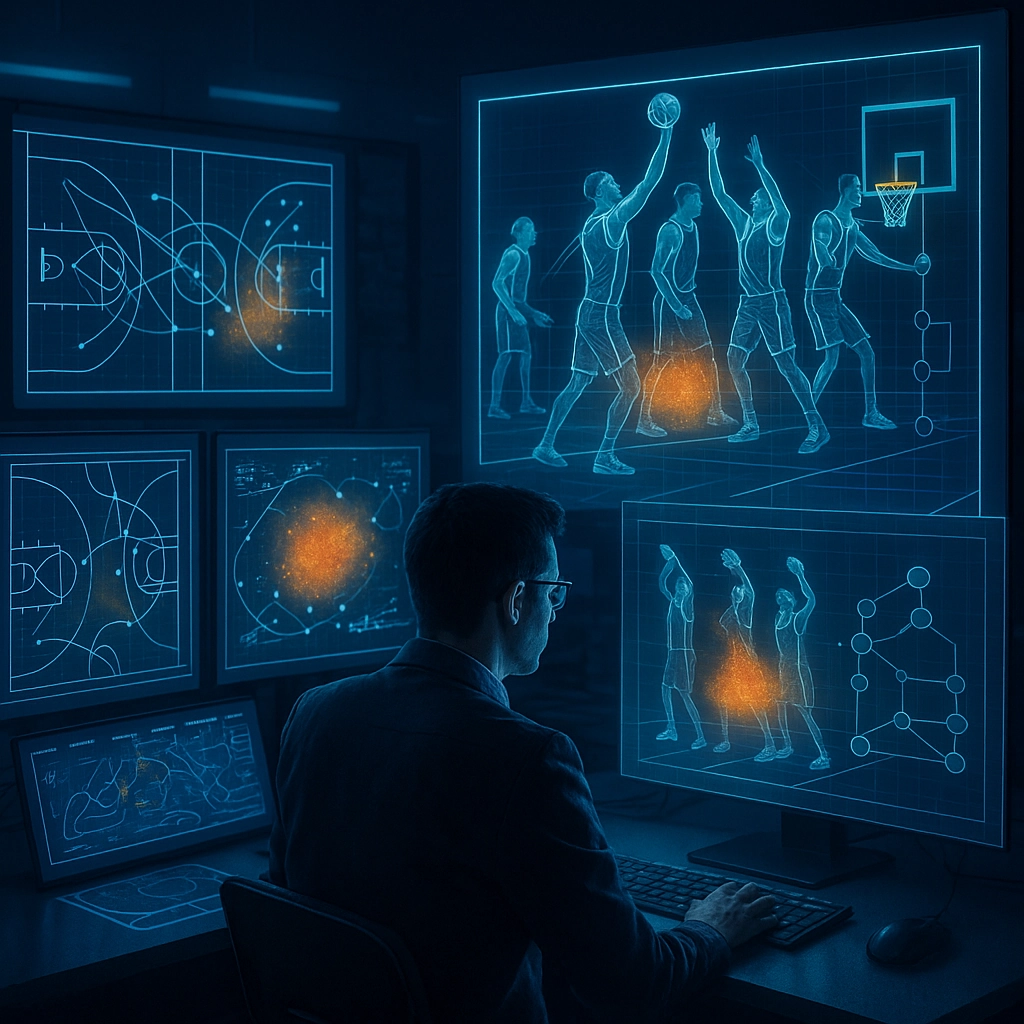
Modern NBA arenas are equipped with sophisticated camera systems that track every player's movement 25 times per second. This creates an enormous dataset that AI algorithms can analyze to detect patterns beyond human perception.
"Player tracking data gives us the 'what' of basketball—where players moved and when," explains Seth Partnow, former Director of Basketball Research for the Milwaukee Bucks. "AI helps us understand the 'why' and predict the 'what next.'"
These systems can evaluate:
- Acceleration and deceleration capabilities
- Change-of-direction efficiency
- Shot mechanics consistency
- Defensive positioning and anticipation
- Court coverage and stamina patterns

Psychological Profiling through Natural Language Processing
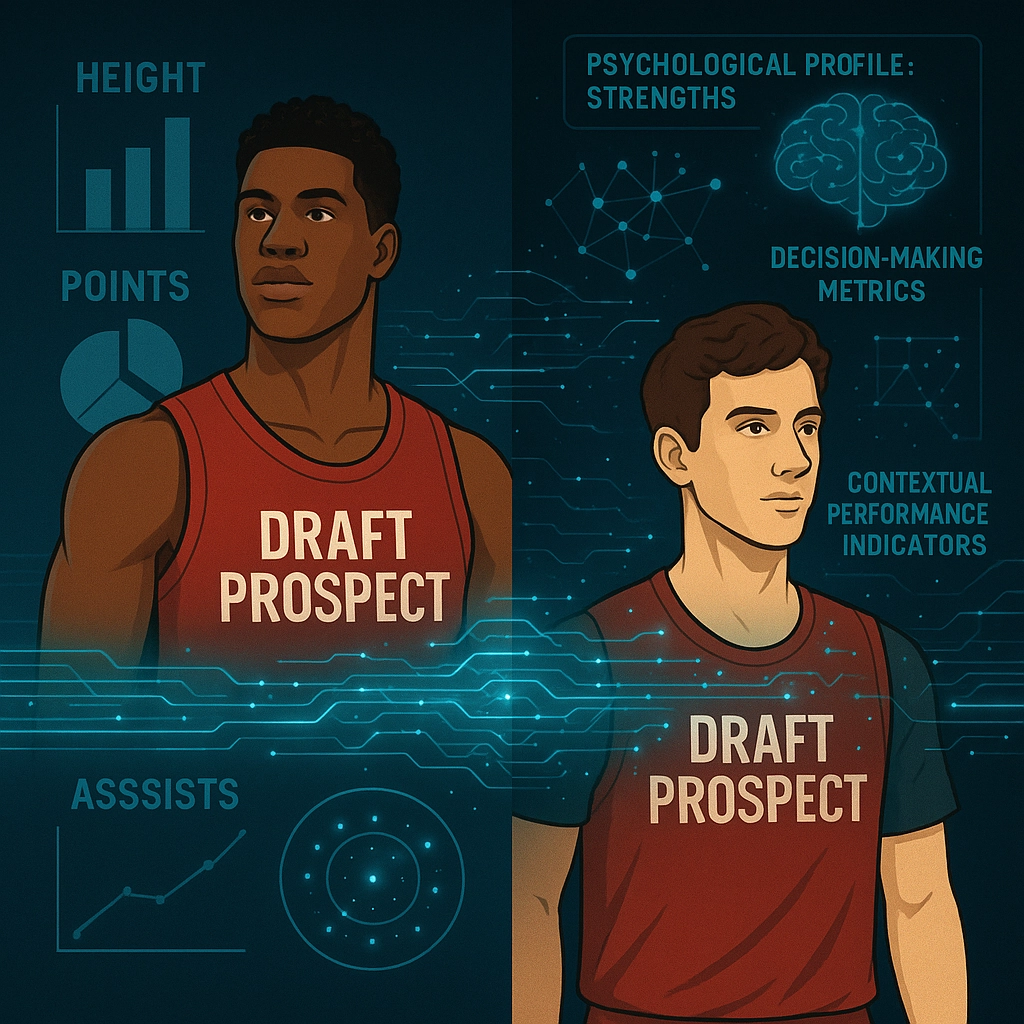
One of the most fascinating applications of AI in talent evaluation is psychological assessment through language analysis. By examining player interviews, social media posts, and other verbal communications, NLP algorithms can identify psychological traits correlated with NBA success.
A groundbreaking study showed that psychological profiles derived from language analysis achieved 63% accuracy in predicting NBA roster success. When combined with physical traits and playing statistics, this accuracy jumped to an impressive 87%.
The psychological factors that predict NBA success include:
- Mental toughness and resilience
- Coachability and adaptation to feedback
- Team-first mentality vs. individual focus
- Competitive drive
- Growth mindset
Contextual Performance Analysis
Traditional statistics treat all points, rebounds, and assists as equal. AI doesn't make this mistake. Modern algorithms can evaluate performance within its proper context by considering:
- Quality of teammates and opponents
- Coaching systems and play types
- Pace and style of play
- Game situation (close game vs. blowout)
- Physical fatigue factors
This contextual intelligence allows AI to identify players whose raw numbers might be suppressed by their current situation but who demonstrate skills that could flourish in a different environment.
From Prediction to Reality: AI Success Stories
While teams closely guard their proprietary AI systems, we can observe where AI-driven insights have likely influenced team decision-making:
The Tyrese Haliburton Example
When Tyrese Haliburton entered the 2020 NBA Draft, traditional scouting was divided on his potential. His unconventional shooting form and slender frame raised concerns. But teams with advanced analytics departments saw something different—elite decision-making metrics, exceptional passing accuracy predictions, and off-the-charts basketball IQ indicators.
The Sacramento Kings selected Haliburton 12th overall, and while they later traded him to Indiana (a decision many question), Haliburton has developed into an All-Star point guard who led the league in assists. AI models likely identified his potential by analyzing:
- His elite assist-to-turnover ratio in college (3.5:1)
- Movement efficiency metrics that compensated for athletic limitations
- Decision-making speed under pressure
- Shot selection optimization
Uncovering Hidden Gems
AI excels at identifying overlooked talents by detecting signal amid noise. Consider Desmond Bane, selected 30th in the 2020 draft, who has outperformed many lottery picks from his class. Traditional evaluators focused on his age (22 on draft day) and limited athletic testing, but AI models would have highlighted:
- Elite shooting mechanics consistency
- Defensive positioning intelligence
- Low-mistake basketball in high-leverage situations
- Complementary skill optimization
The Human Element: Where AI Still Needs Help
Despite its power, AI isn't ready to replace human scouting. Several critical areas still require the human touch:
Character and Chemistry Assessment
While AI can analyze language for psychological traits, it struggles with the nuanced evaluation of character and team fit. Human scouts can observe body language during adversity, interactions with teammates and coaches, and subtle behavioral patterns that even the most sophisticated algorithms might miss.
Developmental Context
AI systems need help understanding the varying developmental paths players take. A prospect with minimal coaching and structure might show lower statistical performance but have massive untapped potential. Human evaluators can contextualize a player's development journey in ways AI cannot fully appreciate.
Injury and Recovery Projection
While AI can analyze movement patterns and identify injury risks, predicting how a player will recover and adapt after injury remains more art than science. Human medical staff and trainers bring invaluable expertise to these assessments.
The ideal approach combines AI's pattern recognition capabilities with human contextual intelligence and experiential wisdom.
Building Your Own AI-Enhanced Scouting Eye
You don't need access to proprietary NBA tools to incorporate AI-driven insights into your basketball analysis. Here's how to develop a more sophisticated evaluation framework:
Focus on Predictive Metrics
Rather than emphasizing counting stats, look at efficiency and impact metrics with greater predictive power:
- True Shooting Percentage instead of raw FG%
- Box Plus/Minus and VORP instead of raw point totals
- Assist-to-Usage ratio instead of raw assist numbers
- Defensive RAPTOR or EPM instead of steals/blocks
Consider Developmental Trajectories
AI models excel at projecting career arcs based on comparable players. When evaluating young talent, consider:
- Age-adjusted production (how a player performs relative to peers the same age)
- Skill improvement rate over time
- Performance stability across different contexts
- Response to increased responsibility
Look Beyond the Numbers
The most sophisticated AI models incorporate video analysis alongside statistics. Train your eye to notice:
- Decision-making speed and quality
- Off-ball movement and court awareness
- Defensive recognition and rotation timing
- Physical tools that could be optimized in different systems
The Future of AI in Basketball Talent Identification
As we look ahead, several emerging trends will shape how AI influences NBA talent evaluation:
Biometric Integration
The next frontier involves integrating biometric data—heart rate variability, sleep patterns, neural response times—with performance analytics. This will create even more comprehensive player profiles and injury prevention protocols.
Global Talent Detection
AI will dramatically expand NBA scouting reach by analyzing footage from youth leagues worldwide, identifying promising talents years before they reach traditional scouting radar. This democratization of talent identification could reshape global basketball development.
Fan Engagement and Fantasy Applications
The tools once exclusive to NBA front offices are becoming increasingly available to fans and fantasy players. Platforms offering AI-powered insights will transform how fans engage with the game and evaluate talent.
Conclusion: The New Talent Identification Paradigm
The future of NBA talent identification lies in the synthesis of artificial and human intelligence. AI provides the analytical horsepower to process vast amounts of data and detect subtle patterns, while human evaluators provide the contextual understanding and experiential wisdom to interpret these insights.
For teams, the competitive advantage no longer comes from having access to data—it comes from asking better questions of that data and integrating AI insights with traditional basketball wisdom. The franchises that master this integration will gain sustainable edges in talent acquisition and development.
For fans, this revolution offers unprecedented insight into the game we love. Beyond the box score lies a deeper understanding of basketball—one that artificial intelligence is helping us access, one algorithm at a time.
The next NBA breakout star is out there right now, perhaps hiding in plain sight. Their potential may not be obvious in traditional statistics, but the patterns of future greatness are there—and AI is getting better at finding them every day.







Add comment